
So, how much is a 3 carat ring? The answer can be anything from $1,000 for a moissanite to well over $45,000 for a natural diamond. The single biggest factor driving that price is the gemstone you choose for the center stage—and your options have never been better.
This guide will walk you through exactly what to expect, demystifying the costs of moissanite, lab-grown diamonds, and their natural counterparts.
How Much a 3 Carat Ring Really Costs
When people hear "3 carat ring," their minds often jump straight to a celebrity-level price tag. And for a long time, they were right. But the modern jewelry world has completely changed the game, making that impressive size a realistic option for far more people. The secret is knowing your choices go way beyond what the traditional diamond industry used to offer.
Today's ring shoppers essentially have three paths for their center stone. While they all deliver a stunning look, their price points are worlds apart.
- Moissanite: This is your most wallet-friendly route. Moissanite is known for its incredible brilliance and fire (that rainbow sparkle), often out-sparkling a diamond for just a tiny fraction of the cost.
- Lab-Grown Diamond: Identical to a natural diamond in every way that matters—chemically, physically, and visually—lab diamonds give you the exact same forever-stone without the astronomical price or the environmental toll of mining.
- Natural Diamond: The classic choice. The high price here is tied to its rarity, the immense cost of pulling it from the earth, and a market history built on tightly controlled supply.
If there's one major shift in jewelry today, it's the understanding that a big, beautiful stone doesn't have to mean a huge budget. Modern alternatives deliver all the "wow" without the financial weight.
Let's put some numbers to this so you can see just how different these paths are. This isn’t a small difference; it’s a complete game-changer for your budget.
To give you a quick snapshot, here’s a table breaking down what you can generally expect to pay for just the 3 carat center stone.
3 Carat Ring Cost at a Glance
| Gemstone Type | Estimated 3 Carat Stone Price | Key Benefit |
|---|---|---|
| Moissanite | $800 - $1,500 | Exceptional brilliance at an unbeatable price |
| Lab-Grown Diamond | $3,000 - $8,000+ | Real diamond beauty without the natural premium |
| Natural Diamond | $25,000 - $45,000+ | The traditional, mined luxury choice |
As you can see, the choice between these stones places you in entirely different financial territories.
The bar chart below paints an even clearer picture of these dramatic price gaps.
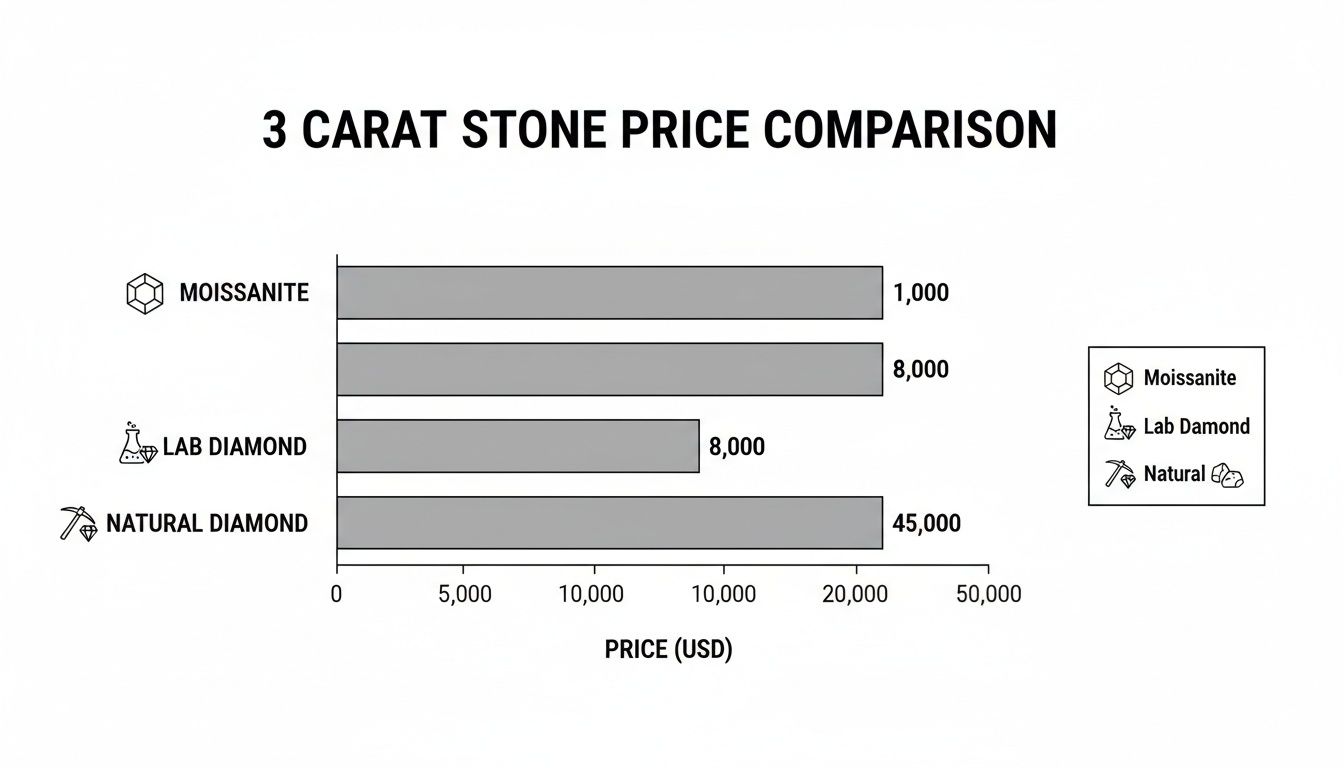
One look at this visual and it's obvious: moissanite and lab-grown diamonds open the door to a stunning 3 carat ring for budgets that would be instantly disqualified from the natural diamond market.
Why Moissanite Delivers Unmatched Brilliance for the Price
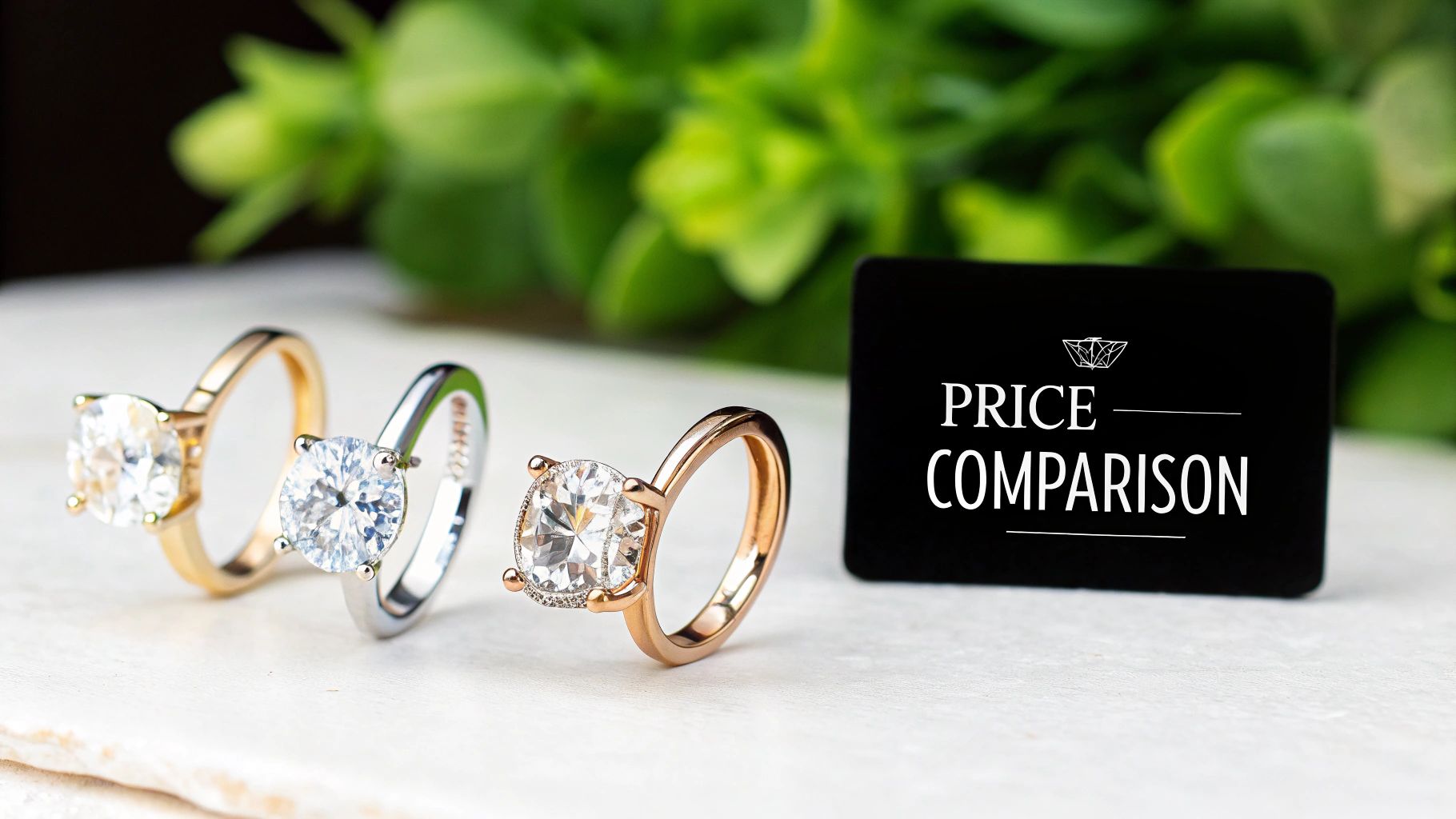
While the incredible price of a 3 carat moissanite ring is a huge plus, its real story goes way beyond the price tag. Moissanite isn't just a budget-friendly substitute for a diamond. In many ways, it's a gemstone with its own superior optical properties, a fascinating blend of cosmic origins and scientific perfection.
The original moissanite was discovered in a meteorite crater by Nobel Prize-winning scientist Henri Moissan—yes, it literally came from the stars. Since natural moissanite is unbelievably rare, the gorgeous stones you see in jewelry today are grown in controlled lab environments. This not only creates a flawless gem but also sidesteps the environmental toll of mining. The secret to its incredible sparkle lies in its unique chemical makeup: silicon carbide.
The Science of Unbeatable Sparkle
The true magic of moissanite is all about how it plays with light. Picture a gemstone as a tiny, intricate prism. When light enters, it splits into a rainbow of colors, an effect gemologists call fire. Moissanite's ability to bend light (its refractive index) is actually higher than a diamond's, which means it creates more dramatic, intense flashes of color.
Here's the key difference: Moissanite has a fire dispersion rating of 0.104, which is more than double a diamond's 0.044. This is the reason you see those stunning, fiery rainbow sparkles dancing in the light. It's not just an alternative; it's a more brilliant one.
This exceptional fire is exactly why so many people are captivated by it. When you're looking for a 3 carat ring, you're not just thinking about the cost; you're looking for maximum visual impact. Moissanite delivers that in a big way.
Built for a Lifetime of Wear
A beautiful ring has to stand up to daily life, and moissanite is one of the toughest materials out there. It scores a 9.25 on the Mohs scale of hardness, making it second only to a diamond (which is a perfect 10). This means it’s extremely resistant to scratches and chipping, making it a smart and practical choice for an engagement ring you’ll wear for a lifetime.
For anyone dreaming of a large, eye-catching ring without the financial headache, moissanite hits that perfect sweet spot of beauty, durability, and incredible value. You can dive deeper into how moissanite delivers maximum sparkle for less in our detailed guide. It's not about settling; it’s about making a smarter choice for affordable luxury.
Understanding the Modern Diamond Market
So, why does the dream of owning a large, impressive ring suddenly feel within reach? The reason is a massive shift in the jewelry world, all thanks to the rise of lab-grown diamonds. This innovation has completely changed the game, making spectacular gems a realistic option for so many more people.
Here’s a good way to think about it: natural diamonds are like rare, wild truffles, found only after an expensive and unpredictable hunt. Lab-grown diamonds, on the other hand, are like perfectly cultivated truffles from a specialty farm. They have the exact same chemical, physical, and visual properties as mined diamonds. The only difference is their origin and, crucially, their price.
This technological leap has sent shockwaves through the traditional diamond market. As the science behind growing flawless diamonds in a lab has gotten better and better, production has scaled up, and prices have dropped—dramatically. We’re not talking about a small discount here; it’s a market disruption that directly benefits you.
How Lab-Grown Diamonds Benefit You
The widespread availability of high-quality, affordable lab-grown stones means you no longer have to compromise between the size you want and the budget you have. This shift puts the power back in your hands, letting you get that impressive 3-carat ring without the kind of financial strain that used to come with it.
The advantages are crystal clear:
- Identical Beauty: A lab-grown diamond is visually and chemically indistinguishable from a natural one. No one, not even a jeweler, can tell the difference just by looking.
- Ethical Peace of Mind: You can be 100% certain your stone is conflict-free and created with a significantly smaller environmental footprint.
- Unbelievable Value: For the same budget, you can get a much larger and higher-quality stone than you ever thought possible.
The rise of lab-grown diamonds isn't just about finding a "cheaper" option. It's about making a smarter, more informed choice that aligns with modern values. It validates looking beyond mined gems for a stone that is every bit as beautiful and far more accessible.
This new reality has created a jaw-dropping price gap between mined and lab-created gems. A 3-carat lab-grown diamond now costs around $2,361, which is a staggering 80% to 90% less than a comparable mined diamond.
This isn't a fleeting trend. In just nine years, lab-grown stones went from being just 1% of diamond sales in 2015 to roughly 20% today. Many experts believe prices have now stabilized near their production floor. You can discover more insights about lab diamond pricing and see how it's shaking up the industry. This shift makes asking "how much is a 3 carat ring" an exciting question with surprisingly affordable answers.
So, Why Are Natural Diamonds So Expensive Anyway?
To really appreciate the incredible value you get with moissanite or a lab-grown diamond, it’s helpful to pull back the curtain on why natural diamonds cost what they do. The price tag isn't just pulled out of thin air; it’s the result of an incredibly long, expensive, and difficult journey from deep inside the Earth to a ring on someone's finger.
Think of it as a global treasure hunt with astronomical costs and zero guarantees. Mining operations are massive, multi-billion dollar ventures. They move literal mountains of earth, burning through cash on equipment, energy, and labor, all to find just a few carats of gem-quality diamonds. This built-in rarity and the sheer difficulty of extraction are the cornerstones of their price.
Once a rough diamond is out of the ground, its journey is far from over. It enters a complex, tightly controlled supply chain, passing through the hands of expert cutters, polishers, graders, and distributors. Every one of those stops adds a little more to the final cost.
How the Four Cs Send Prices Soaring
You’ve probably heard of the "4 Cs"—Cut, Color, Clarity, and Carat. They’re the universal grading system for diamonds, and they act like powerful price multipliers. When you get to a 3-carat stone, even the tiniest shifts in these grades can make the price jump or fall by tens of thousands of dollars.
- Color: The dream is a chemically pure, perfectly structured diamond that is totally colorless (a D grade). These are the rarest and, you guessed it, the most expensive. Dropping down to a G or H grade introduces a faint yellow tint that’s usually invisible to the naked eye but can save you a small fortune.
- Clarity: This is all about the absence of internal flaws (called inclusions) or surface blemishes. A "Flawless" diamond is practically a museum piece. On the other hand, a "Very Slightly Included" (VS) stone looks perfectly clean to the eye and comes with a much more realistic price.
- Cut: Many experts will tell you this is the most important C of all. The cut is what gives a diamond its life—its fire and brilliance. An "Excellent" cut will make a diamond dance with light and always commands a premium over a poorly cut stone of the exact same size.
It's when you put all these factors together that the puzzle of natural diamond pricing really clicks into place. A 3-carat, D-color, Flawless diamond is a true miracle of nature, and its price tag absolutely reflects that mind-boggling rarity.
Market data shows that large, high-quality natural diamonds hold their own as a luxury asset. While prices for common 1-carat diamonds have dipped recently, the index for 3-carat diamonds has actually nudged up a bit. A retail engagement ring with a good-quality natural three-carat stone will typically start in the $15,000 to $25,000 range and can easily go much, much higher. You can learn more about recent diamond price trends to get a better sense of how the market is moving.
How Settings and Metals Influence Your Final Price
The center stone might be the star of the show, but the setting—the metal framework that holds it—is the unsung hero. It's what gives the ring its personality and, you guessed it, plays a huge role in the final price tag. Think of it this way: the 3-carat stone is the main event, but the setting is the venue that makes it all shine.
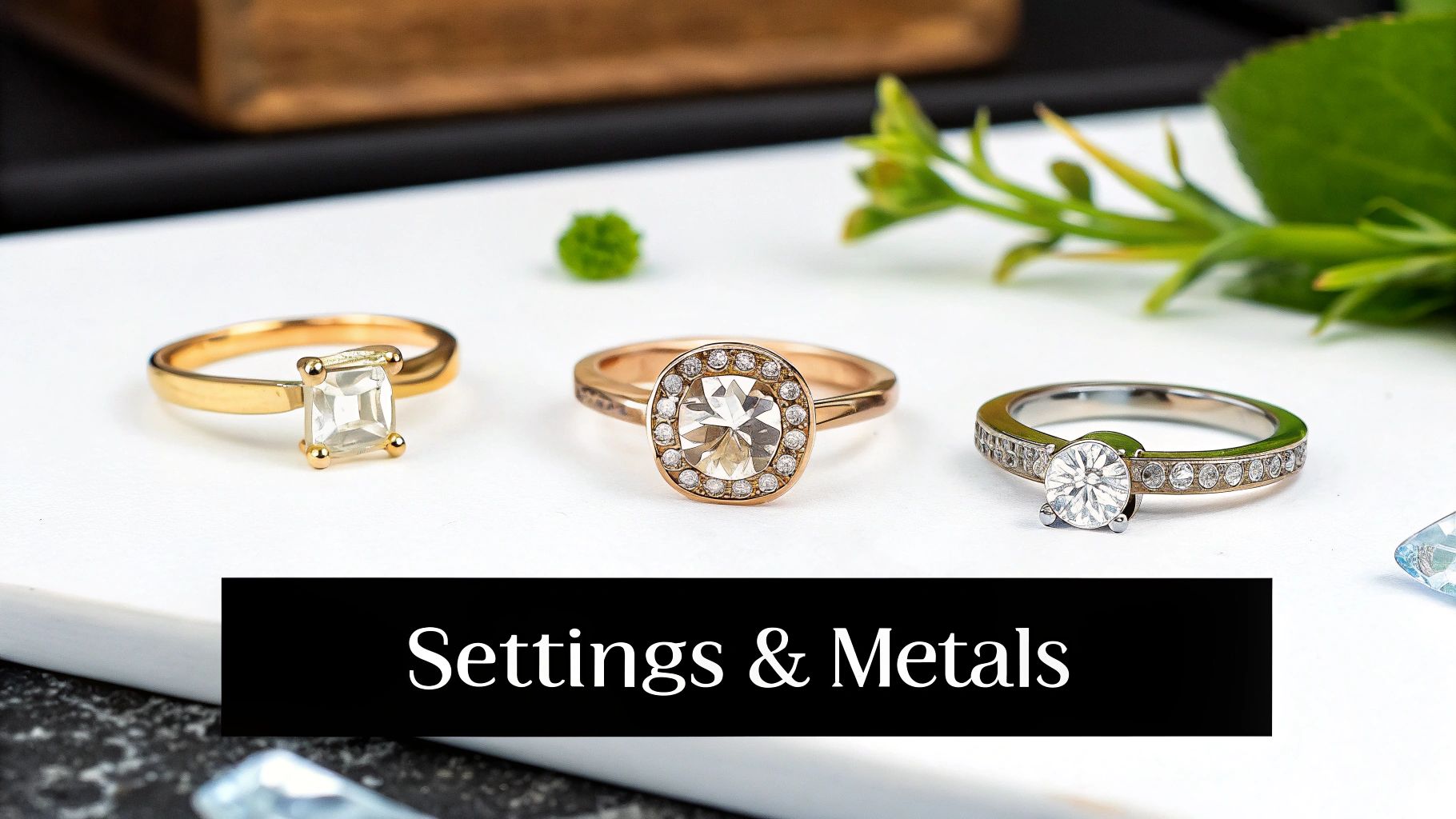
A classic solitaire setting is your most straightforward and cost-effective choice. It’s elegant, timeless, and puts all the focus squarely on that gorgeous 3-carat stone. But if you’re after a little more flash, things can get more interesting.
Setting Styles and Their Cost
As you move into more intricate designs, the price naturally starts to climb. This is because more complex settings require more precious metal, more labor from a skilled jeweler, and often, more tiny diamonds.
Here’s a quick rundown of how different styles stack up:
- Pave Settings: If you love the idea of a band that looks like it's paved with diamonds, this is it. Tiny stones are set closely together, creating a seamless, glittering surface. It’s beautiful, but it adds to both the material and labor costs.
- Halo Settings: This is a hugely popular choice for a reason. A "halo" of smaller diamonds encircles the main stone, which not only adds a ton of sparkle but also creates the illusion of an even bigger center gem. A halo can easily add $1,000 to $2,500+ to the ring's price.
- Three-Stone Settings: Symbolizing the past, present, and future, this style flanks your 3-carat stone with two smaller side stones. It's a breathtaking look, but you're also adding the cost of two additional gems to the final bill.
The right setting does more than just hold the stone; it defines the ring's entire personality. Choosing a more complex design is an investment in the ring's overall artistry and visual impact.
Choosing Your Precious Metal
The metal you choose for the band is another key decision that impacts both the look and the cost. Platinum and various shades of gold are the go-to options, and each has its own set of pros and cons.
Here’s a simple breakdown to help you decide.
Comparing Precious Metals for Your Ring
| Metal Type | Relative Cost | Best For | Maintenance Notes |
|---|---|---|---|
| Platinum | Highest | The ultimate in durability; hypoallergenic. | Naturally white, so no replating needed. Scratches can create a "patina" finish. |
| 18k Gold | High | A rich, luxurious feel with high gold content. | Softer than 14k, so it's more prone to scratching. Great for special occasion pieces. |
| 14k Gold | Medium | The perfect balance of durability and gold purity. | The most popular choice for everyday wear. Strong and holds up well to life. |
| 10k Gold | Lowest | Maximum durability for very active lifestyles. | Less pure gold content, but incredibly tough and budget-friendly. |
Essentially, platinum is the top-tier choice—it's incredibly strong, naturally white, and hypoallergenic. But it's also the densest and rarest, making it the most expensive. Gold gives you more flexibility. It’s almost always mixed with other metals (alloys) to make it stronger, which is where "karats" come in. 14k gold is a fantastic all-rounder, while 18k gold has a richer color due to its higher gold content.
If you're feeling inspired to create something truly one-of-a-kind, you can dive deeper into how to design an engagement ring from the ground up. Our guide will walk you through every step, helping you bring your vision to life within your budget.
Making a Smart Purchase in Today's Market
The way people shop for rings has completely changed. Today, it’s not just about tradition. Shoppers are savvier than ever, demanding transparency, ethical sourcing, and, most importantly, getting the absolute most for their money. These aren't just nice-to-haves anymore; they're dealbreakers.
This shift in thinking has opened the door wide for stunning alternatives like moissanite and lab-grown diamonds. They perfectly match this modern mindset, delivering all the beauty and brilliance you could want without the ethical baggage or eye-watering price tags of mined gems. You're in the driver's seat now.
The price drop for lab-created stones has been nothing short of staggering. Think about it: an engagement ring price report shows a ring that might have cost £20,000 with a natural diamond can now be had for around £1,500 with an equivalent lab-grown stone. That’s a jaw-dropping 92.5% difference. It’s easy to see why so many people are choosing bigger, better lab stones for their budget.
Embracing Value Without Compromise
Let's be clear: choosing a lab-grown diamond or moissanite for your 3 carat ring isn't a compromise. It’s a genuinely smart financial move. It's about realizing you can have the size, the sparkle, and the spectacular "wow" factor you've dreamed of, but in a way that feels right for today.
Luxury is being redefined. People are realizing that the real value of a ring is in its beauty and the happiness it brings—not where it came from or an artificially high price.
When you opt for a lab-created stone, you're putting your money where you can see it: into a bigger, brighter gem. This frees up your budget, allowing you to go all-out on a custom setting or simply keep a significant amount of cash in your pocket.
This is more than just a passing trend; it’s a more intelligent way to approach buying jewelry. By understanding the true cost of owning moissanite vs diamonds, you can confidently make a choice that is both gorgeous and financially sound for years to come.
Answering Your Final Questions About 3 Carat Rings
Even with all the information, a few last-minute questions always seem to surface right before you make a decision. Let's tackle those common head-scratchers so you can move forward with total confidence.
Is a 3 Carat Ring Just Too Big for Daily Life?
Not at all! A 3 carat ring is definitely a showstopper, but it's absolutely something you can wear every day. The trick is to pick the right setting. A lower-profile design, like a bezel setting that wraps the stone in metal or a classic four-prong solitaire, is far less likely to snag on your favorite sweater than a super high or intricate setting.
Plus, remember what we're working with here. Moissanite scores a 9.25 on the Mohs scale of hardness, just a whisper behind diamond's perfect 10. These stones are incredibly tough and built to handle the bumps and scrapes of daily life, so you can flash that sparkle without a second thought.
Can People Tell if It's Moissanite or a Lab Diamond?
Honestly? The chances are almost zero. To the naked eye, a top-quality moissanite or lab-grown diamond looks identical to a natural one. Sure, a jeweler with a loupe and specialized tools could spot the difference, but your friends, family, and that curious coworker will just see a gorgeous, brilliant gemstone.
The one giveaway, which many people actually prefer, is moissanite's fiery sparkle. It tends to throw off more rainbow flashes than a diamond. A lab diamond, on the other hand, is the same stuff as a mined diamond, right down to the atom—they are optically and chemically identical.
What’s the Best Setting for a 3 Carat Stone?
This really comes down to your personal style and the look you’re going for. There isn't one "best" answer, but these are consistently the most popular choices for a reason:
- The Solitaire: You can't go wrong with this timeless classic. It’s all about putting that stunning 3 carat stone front and center.
- The Halo: Want even more bling? A halo surrounds the center stone with a ring of smaller gems, which not only adds sparkle but creates the illusion of an even larger stone.
- The Three-Stone: This setting is rich with meaning. Two smaller stones flank your main gem, beautifully symbolizing your past, present, and future as a couple.
At the end of the day, whether you're asking how much is a 3 carat ring or how to set it, the perfect choice is always the one that speaks to you and fits comfortably within your budget.
Ready to see how breathtaking beauty and incredible value come together? Explore the curated collections at Moissanite Diamond and find the ring you'll cherish for a lifetime. Shop our brilliant moissanite rings today!